When choosing which Berry specialists to raise in Pokémon Sleep, I generally prioritize Berry Finding S (BFS) above everything else.
However, I don’t automatically raise every Pokémon that has BFS. I also consider Helping Bonus, Helping Speed, Natures, the levels at which Sub Skills unlock, and how difficult the Pokémon is to hunt.
Most importantly, I look at how much that Pokémon would actually improve my current team.
In this guide, I’ll explain my personal selection criteria for Berry specialists, including examples of Pokémon I’ve raised and why I decided to invest in them.
目次
- Your Selection Standards Should Depend on Your Current Team
- Berry Finding S Is My Highest Priority
- Five Berry Specialists I Recommend Raising Early
- Best Sub Skills for Berry Specialists
- Best Natures for Berry Specialists
- At What Level Should Berry Finding S Unlock?
- When Should You Stop Hunting for a Better Berry Specialist?
- Final Thoughts: Choose Berry Specialists Based on Your Needs
Your Selection Standards Should Depend on Your Current Team
My standards for Berry specialists change depending on how much progress I’ve made and which Pokémon I’ve already raised.
If you’re still building your first reliable teams, I recommend raising a Pokémon with Berry Finding S even if its other traits aren’t particularly impressive.
For example, Snorlax prefers Fire-, Rock-, and Ground-type Berries at Taupe Hollow.
If you don’t have a strong Berry specialist for any of those types, raising a Vulpix or Mudkip with BFS can make the area significantly easier to handle.
Earning more Snorlax Strength can improve your sleep research results, giving you opportunities to encounter more Pokémon and obtain more Dream Shards, Research EXP, and Pokémon Candies.
Building a reliable team early can make future hunting and training easier.
On the other hand, if you can already earn plenty of Strength at Taupe Hollow, you don’t necessarily need to rush into raising another Berry specialist.
For example, if you’ve already raised a strong Swampert, you might choose to be more selective when hunting Cubone or invest in Pokémon for another area instead.
That’s why I don’t evaluate Pokémon based on their individual strength alone. I also consider how much value they would add to my existing team.
Berry Finding S Is My Highest Priority
For most Berry specialists, I consider Berry Finding S an essential Sub Skill.
Berry specialists normally collect two Berries per Berry help. With BFS, that increases to three, providing 50% more Berry Strength whenever they find Berries.
I’ve previously compared three different Lv. 50 Raichu builds.
The results showed that a Raichu with only BFS could generate almost the same total daily Strength as one with Helping Speed M, Helping Speed S, and a Helping Speed-increasing Nature.
That demonstrates just how powerful BFS can be for Berry specialists.
For a detailed comparison, including the calculations and how BFS performs on Ingredient and Skill specialists, see my separate guide.
Is Berry Finding S Worth It? How to Evaluate It for Different Specialties
Five Berry Specialists I Recommend Raising Early
During the early days of Pokémon Sleep, players sometimes referred to five especially useful Berry specialists as the “Big Five.”
These included Raichu, Walrein, and the fully evolved forms of the original starter Pokémon.
The available Pokémon have changed considerably since then, so I wouldn’t necessarily recommend following the same list today.
If I were building a new account, these are the five Pokémon I would prioritize.
| Pokémon to Hunt | Final Evolution | Main Reason to Raise It |
|---|---|---|
| Pikachu | Raichu | A versatile Berry specialist for early-game teams |
| Mudkip | Swampert | Strong at Taupe Hollow with a useful Main Skill |
| Torchic | Blaziken | Useful at Lapis Lakeside, with Charge Energy S |
| Piplup | Empoleon | Valuable Steel-type Berry specialist with a useful Main Skill |
| Spheal | Walrein | Strong at Snowdrop Tundra and useful for Holiday events |
Raichu Is My First Recommendation
If you’re just starting Pokémon Sleep, I recommend trying to obtain a Pikachu with Berry Finding S.
If you’re willing to reroll your starting Pokémon, aiming for a BFS Pikachu is a reasonable option.
Raichu remains a strong Berry specialist and can contribute a considerable amount of Strength during the early stages of the game.
It won’t be the optimal choice for every area, but it can remain useful until you’ve built more specialized teams.
If I found a Pikachu with BFS early on, I’d seriously consider raising it even if its other Sub Skills and Nature were fairly average.
Build a Reliable Berry Specialist for Each Area
The other four Pokémon are useful because of their area coverage and Main Skills.
Swampert is a strong Ground-type Berry specialist for Taupe Hollow. Its Tasty Chance S Main Skill also increases the chance of a dish being Extra Tasty, giving it value beyond Berry production.
Blaziken is useful at Lapis Lakeside and has Charge Energy S. Since it can restore its own Energy, it can perform well even before you’ve fully developed a reliable healer.
Empoleon is a valuable Steel-type Berry specialist with Extra Helpful S. Its combination of Berry production and Main Skill utility makes it useful beyond Old Gold Power Plant.
Walrein is one of my recommended Pokémon for Snowdrop Tundra. It provides solid Berry Strength and useful Main Skill support. Ice-type Pokémon have also been valuable during previous Holiday events, which gives Walrein another reason to consider raising it.
However, this is not a ranking of the five strongest Berry specialists in the game.
These are Pokémon I consider particularly useful when building your first teams.
If you’ve already raised another Pokémon that covers the same role, there’s no need to raise all five.
Best Sub Skills for Berry Specialists
After securing Berry Finding S, I place the most value on Helping Bonus and Helping Speed Sub Skills.
Here is how I generally evaluate them.
| Sub Skill | My Evaluation |
|---|---|
| Berry Finding S | Highest priority |
| Helping Bonus | Excellent |
| Helping Speed M | Excellent |
| Helping Speed S | Very good |
| Skill Level Up M | Depends on the Main Skill |
| Skill Trigger M / S | Depends on the Main Skill |
| Inventory Up | Usually low priority |
Why I Value Helping Bonus So Highly
If I had to choose between a Pokémon with BFS + Helping Speed M and one with BFS + Helping Bonus, I would personally prefer the second option.
Helping Speed M may produce better results for the individual Pokémon, depending on the circumstances.
However, Helping Bonus reduces the helping time of the entire team.
I find this particularly valuable on Berry specialists because they often remain on the team for long periods.
For example, I might temporarily bring in an Ingredient specialist to collect what I need for a particular recipe. Once I’ve gathered enough ingredients, I can replace it with a Berry specialist.
A Berry specialist with Helping Bonus can continue producing Strength while improving the efficiency of the other Pokémon on the team.
The ability to contribute both personal Berry Strength and team-wide helping speed is why I value Helping Bonus so highly.
For a more detailed explanation, see my separate article.
Is Helping Bonus Worth It? Why I Recommend This Sub Skill
Helping Speed M and S Are Also Excellent
Helping Speed M and Helping Speed S increase the frequency of a Pokémon’s help, allowing it to gather Berries more often.
Both work particularly well alongside Berry Finding S.
A Pokémon with BFS and Helping Speed M is already a very attractive candidate, even without Helping Bonus.
Although I personally prefer Helping Bonus because of its team-wide benefits, Helping Speed can be just as valuable when maximizing an individual Pokémon’s Strength production.
Skill-Related Sub Skills Depend on the Main Skill
Some Berry specialists have Main Skills that provide additional utility.
For example, Swampert has Tasty Chance S, while Salamence has Cooking Power-Up S.
These abilities can support your cooking strategy while the Pokémon continues gathering Berries.
For Pokémon like these, Skill Level Up M or Skill Trigger Sub Skills can provide additional value.
However, I still prioritize BFS and helping performance first.
I generally treat Main Skill improvements as bonuses rather than the primary reason to choose a Berry specialist.
Best Natures for Berry Specialists
I value both Helping Speed-increasing Natures and EXP-increasing Natures.
Although Helping Speed provides an immediate performance improvement, EXP gains can be extremely valuable for Pokémon that take a long time to raise.
I am also fairly cautious about EXP-reducing Natures.
Helping Speed Up and EXP Up Are Both Valuable
A Helping Speed-increasing Nature directly improves a Berry specialist’s performance.
EXP gains, on the other hand, help it reach higher levels sooner.
Since the Strength of individual Berries increases with a Pokémon’s level, faster training can translate into better practical performance over time.
One example from my own team is Dodrio.
I chose to raise my Dodrio partly because of its EXP-increasing Nature.
In my situation, I rarely had opportunities to hunt Doduo, and obtaining enough Doduo Candies was difficult.
That made easier leveling a meaningful advantage.
However, I might evaluate the same Nature differently on a Pokémon like Piplup.
Piplup is available in several areas, and I expect to have more opportunities to obtain its Candies through research, friends, and events.
In that situation, I would slightly prefer a Helping Speed-increasing Nature over an EXP-increasing one.
Both are excellent outcomes, but the harder a Pokémon is to train, the more I appreciate EXP gains.
Why I’m Cautious About EXP Down Natures
EXP-reducing Natures are among the traits I evaluate most carefully.
Berry specialists benefit greatly from reaching high levels, so anything that slows their training can become a significant long-term disadvantage.
My Salamence is a good example.
It has a Quiet Nature, which increases ingredient finding and reduces EXP gains.
That’s far from ideal for a Berry specialist, but I decided to raise it because of its exceptional Sub Skills.
- Berry Finding S
- Helping Bonus
- Helping Speed M
- Helping Speed S
- Skill Trigger S
Having BFS, Helping Bonus, and both Helping Speed Sub Skills makes it an unusually strong individual.
Salamence also benefits from the high Strength of Dragon-type Berries and has Cooking Power-Up S as its Main Skill.
I often play without a Good Camp Ticket, so having another way to expand my cooking pot is useful.
Considering all these advantages, I felt that finding a better Salamence would be extremely difficult.
I therefore decided to accept the EXP penalty.
Training it has been challenging, but I’m satisfied with the decision because it contributes through both Berries and its Main Skill.
That doesn’t mean I would automatically raise any Pokémon with BFS and Helping Bonus if it had an EXP Down Nature.
If I already had sufficient coverage or if the Pokémon were relatively easy to hunt, I might continue looking.
There’s also an important practical consideration: two Pokémon receiving the same amount of training resources may reach different levels because of their Natures.
An EXP Up Pokémon could potentially make up some of its lower helping performance through higher Berry Strength at a greater level.
The outcome depends on the Pokémon, its build, and the resources available, so I wouldn’t treat this as a universal rule.
I care about how strong a Pokémon can realistically become, not just its theoretical performance when fully trained.
Are Helping Speed Down and Ingredient Finding Up Acceptable?
A Helping Speed-reducing Nature is certainly a disadvantage for a Berry specialist, but I don’t necessarily consider it as serious as an EXP penalty.
For example, if a Pokémon has BFS and Helping Speed M, I might still raise it despite a Helping Speed Down Nature.
The additional Helping Speed Sub Skill can partially compensate for the disadvantage.
Ingredient Finding Up is another trait I don’t evaluate as harshly as I once did.
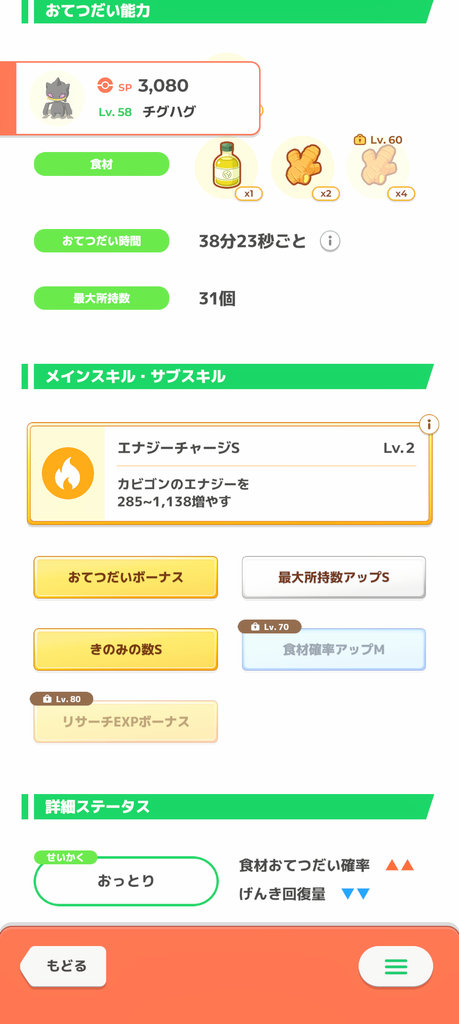
My Banette has both BFS and Helping Bonus, but its Nature increases ingredient finding while reducing Energy recovery.
That’s not ideal if the goal is to maximize Berry Strength.
However, I’ve found that the ingredients it collects can still be useful.
For example, Ginger and Oil can contribute toward recipes I regularly prepare.
With powerful recipes requiring large quantities of ingredients, even the smaller amounts provided by Berry specialists can help.
Of course, the value depends on your existing Ingredient specialists.
If you already have a Skeledirge that supplies more than enough Apples, extra Apples from a Raichu might not be particularly useful.
There’s also the option of leaving a Berry specialist’s inventory full and using Sneaky Snacking.
In that situation, Ingredient Finding Up no longer affects its subsequent Berry production in the same way, although it also prevents further Main Skill trigger rolls while the inventory remains full.
I wouldn’t actively seek Ingredient Finding Up on Berry specialists, but I also wouldn’t reject an otherwise strong Pokémon solely because of it.
At What Level Should Berry Finding S Unlock?
When evaluating a Berry specialist, I always check when BFS becomes available.
For my first Pokémon of a particular role, I generally prefer BFS at Lv. 10, 25, or 50.
However, there are circumstances where I would consider a build with important Sub Skills at Lv. 70 or 80.
When Would I Accept BFS at Lv. 70 or 80?
If BFS is locked behind Lv. 70 or 80, the Pokémon must spend a very long time operating without its most important Sub Skill.
That’s a significant disadvantage, especially if I need it to contribute immediately.
I would generally avoid such builds.
Possible exceptions include Pokémon that are difficult to hunt, such as Sneasel or Onix, particularly when their earlier Sub Skills are excellent.
For example, imagine a Pokémon with Helping Speed M and Helping Bonus available early, alongside a Helping Speed-increasing Nature.
Even before unlocking BFS, that Pokémon could still provide meaningful value.
If it eventually unlocks BFS at a high level, its long-term potential becomes even better.
I might consider raising such a Pokémon if finding another strong individual would be especially difficult.
However, I would be much less willing to make the same compromise for an easily obtainable Pokémon.
Early BFS Makes Late Helping Bonus More Attractive
The reverse situation is much easier to accept.
If a Pokémon unlocks BFS early, I don’t mind waiting until Lv. 70 or 80 for another excellent Sub Skill.
My Weavile is a good example.
It unlocks Berry Finding S at Lv. 25, but Helping Bonus is in its Lv. 80 slot.
Reaching that level will take a considerable amount of time, but the Pokémon can already perform its main role once BFS is available.
Sneasel is also difficult to hunt repeatedly, so I didn’t want to spend an excessive amount of time looking for a more perfect individual.
I decided that early BFS combined with the long-term potential of Helping Bonus was enough to end my search.
A Pokémon with BFS at Lv. 25 and Helping Bonus at Lv. 80 is very different from one that doesn’t unlock BFS until Lv. 80.
The former can contribute throughout its training, while the latter must wait much longer to reach its intended performance.
When Should You Stop Hunting for a Better Berry Specialist?
My decision to stop hunting depends on both the Pokémon itself and my current team.
These are the general standards I use.
| Situation | My Approach |
|---|---|
| My team still lacks Berry specialists | Accept early BFS even with average other traits |
| I already have strong coverage | Look for BFS plus additional advantages |
| The Pokémon is relatively easy to hunt | Be more selective about Helping Bonus or Helping Speed |
| The Pokémon is difficult to hunt | Consider ending the search once I find a suitable BFS individual |
Be More Selective When Your Team Is Already Strong
One of my strongest Berry specialists is Steelix.
It has BFS, Helping Speed M, and a Helping Speed-increasing Nature.
Its performance is high enough that, in some calculations for Snowdrop Tundra, it can even outperform my Raticate despite Raticate collecting one of Snorlax’s preferred Berries.
This is a reminder that an exceptionally strong Pokémon can contribute outside its preferred areas.
If you already have Pokémon capable of performing at this level, you may not need to raise every new Berry specialist you encounter.
For example, I would be more selective when considering Butterfree or Arbok if I didn’t currently have a specific need for them.
In those situations, I would prefer a Pokémon with BFS plus Helping Bonus or additional Helping Speed.
Don’t Overinvest in Hunting Rare Pokémon
Some Pokémon are considerably harder to hunt than others.
Sneasel and Onix, for example, require more Friendship Points than common Pokémon and may be difficult to encounter consistently.
My own Onix has BFS and a Helping Speed-increasing Nature, but its other traits aren’t particularly impressive.
I still decided to stop hunting because the cost of repeatedly finding and befriending Onix didn’t seem worthwhile.
I’m satisfied with its performance for the role I wanted it to fill.
Of course, the game continues to introduce new alternatives.
With Pokémon such as Tyrantrum now available, I might evaluate the priority of raising Onix differently today.
But the underlying principle remains the same.
Before continuing to hunt, I consider whether I actually need a stronger Pokémon, whether I have alternatives, and how difficult finding an improvement would be.
Final Thoughts: Choose Berry Specialists Based on Your Needs
Berry Finding S is my highest priority when evaluating most Berry specialists.
Helping Bonus, Helping Speed, Nature, and the levels at which Sub Skills unlock are also important.
However, I don’t use one rigid standard for every Pokémon.
If your team is still developing, a Pokémon with BFS alone may be more than enough to help you progress. If you already have strong coverage, you can afford to be more selective.
Personally, I place more value on how much raising a Pokémon will improve my current gameplay than on waiting indefinitely for a theoretically perfect individual.
That’s the approach I use when deciding which Berry specialists are worth raising in Pokémon Sleep.