When choosing which Pokémon to raise in Pokémon Sleep, it’s common to wonder whether an individual is good enough or whether you should keep hunting for something better.
My highest priority is whether a Pokémon can fulfill the role I need it to perform. I also consider my existing team, how difficult the Pokémon is to find, and the resources required to raise it.
In this article, I’ll explain my personal selection criteria using examples from Pokémon I’ve actually raised, including how I decide when to stop hunting and when to start investing resources.
目次
- What I Prioritize When Choosing Pokémon
- My Selection Criteria for Berry Specialists
- My Selection Criteria for Ingredient Specialists
- My Selection Criteria for Skill Specialists
- I Don’t Judge Natures Simply as Good or Bad
- I Also Consider Strengths Outside a Pokémon’s Main Specialty
- Whether You Need a Pokémon Right Now Also Matters
- Stopping Your Hunt and Starting Training Are Different Decisions
- What Influenced My Personal Selection Criteria
- There Isn’t One Correct Way to Choose Pokémon
- Final Thoughts: Build Selection Standards That Work for You
What I Prioritize When Choosing Pokémon
Before evaluating Sub Skills or Natures, I decide what I want a Pokémon to accomplish.
- Berry specialists: Can they generate enough Snorlax Strength through Berries?
- Ingredient specialists: Can they collect enough of the ingredients I need for my recipes?
- Skill specialists: Can they activate their Main Skill frequently enough to fulfill their role?
Once those requirements are met, I consider additional advantages such as Helping Bonus and other valuable Sub Skills.
A Strong Sub Skill Alone Doesn’t Make a Pokémon Worth Raising
For example, I place a very high value on Helping Bonus. However, I wouldn’t raise a Pokémon simply because it has Helping Bonus.
For Ingredient specialists, the ingredient spread comes first. For Skill specialists, the ability to activate their Main Skill consistently is more important. Even an excellent Sub Skill may not be enough if the Pokémon struggles to fulfill its intended role.
On the other hand, a Pokémon that meets its primary requirements and also has Helping Bonus becomes a much more attractive candidate.
I’ve explained why I value Helping Bonus in more detail here:
Is Helping Bonus Worth It? Why I Recommend This Sub Skill
Raise Your Standards If You Already Have a Pokémon for the Same Role
Another important consideration is your current team.
If you already have a Pokémon that performs a particular role well, there’s no need to rush into raising another one. You can afford to keep hunting until you find a Pokémon with better Sub Skills or a more suitable Nature.
However, if you don’t have anyone capable of filling that role, raising a less-than-perfect individual can be worthwhile.
That’s why I always ask myself: “Will raising this Pokémon actually improve my current team?”
My Selection Criteria for Berry Specialists
For Berry specialists, I generally prioritize Berry Finding S (BFS) above everything else.
However, my standards depend on whether I’m raising my first reliable Berry specialist or looking for an upgrade to an already strong team.
For example, if I found a Pikachu with BFS early in the game, I’d consider raising it even if its other traits were fairly average. But if I already had several strong Berry specialists, I’d want additional advantages such as Helping Bonus or Helping Speed.
I also value ease of training. Berry Strength increases as a Pokémon levels up, so an EXP-increasing Nature can be especially useful when Candies are difficult to obtain.
For detailed selection criteria, including recommended Natures, Sub Skills, Lv. 70 and 80 unlocks, and when to stop hunting, see my dedicated guide:
Berry Specialist Selection Guide (Japanese Edition)
For an explanation of Berry Finding S itself, including how it performs across different specialties, see the following article:
Is Berry Finding S Worth It? How to Evaluate It for Different Specialties
My Selection Criteria for Ingredient Specialists
For Ingredient specialists, the first thing I check is whether the Pokémon has the ingredient spread I want.
For example, if I’m raising Blastoise specifically to gather Moomoo Milk, I might look for an AAA spread that provides Moomoo Milk in all three ingredient slots.
Once I’ve found the right ingredient spread, I evaluate Ingredient Finder M, Helping Speed, Helping Bonus, and Inventory Up. My usual target is a Pokémon with the desired ingredients and Ingredient Finder M unlocked by Lv. 50.
However, I’m willing to make exceptions if a Pokémon can already collect the amount of ingredients I need.
I’ll Accept an Imperfect Pokémon If It Can Supply Enough Ingredients
My Blastoise is a good example of this approach.
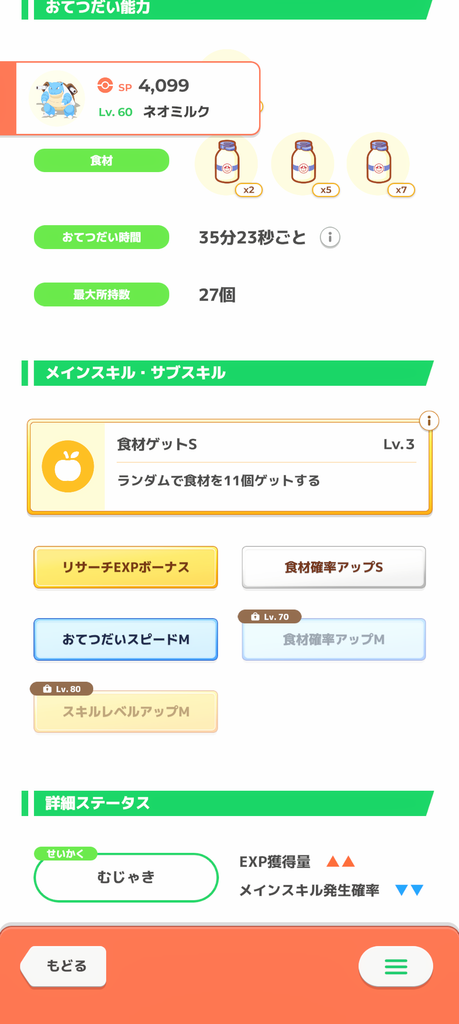
This Blastoise has the ingredient spread I wanted, but it doesn’t have Ingredient Finder M. Instead, it has Helping Speed M and Ingredient Finder S.
At the time, I needed 123 units of a particular ingredient per day to prepare three servings of the avocado gratin recipe I was targeting. After checking its expected ingredient production at Lv. 60, I concluded that this Blastoise could just about meet my requirements.
Of course, a Blastoise with Ingredient Finder M would perform better. But continuing to hunt would also cost Biscuits and time that I could spend on other Pokémon.
If a Pokémon can reliably collect the ingredients I actually need, I’m willing to accept a build that falls short of my ideal.
Inventory Up Can Be Very Valuable Depending on How You Use a Pokémon
For Ingredient specialists, I also consider how efficiently I can collect the ingredients I need, rather than looking only at production rates.
For example, my Bewear has both Inventory Up M and Inventory Up L.
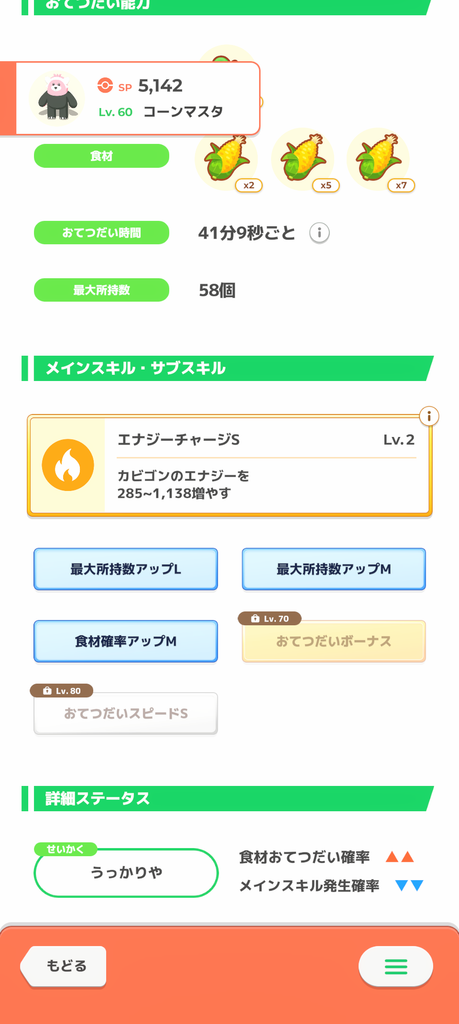
When I add it to my team before going to sleep, I sometimes wake up to find that it has collected more than 40 Greengrass Corn.
Once I’ve collected enough Corn, I can replace Bewear with a Berry specialist or another Pokémon that serves a different purpose.
That’s why I value the ability to gather a large amount of ingredients in a limited amount of time and free up a team slot afterward.
For more details about ingredient spreads, Sub Skills, and Natures, see:
Pokémon Sleep Ingredient Specialist Selection Guide: Ingredient Sets, Natures, and Sub Skills
My Selection Criteria for Skill Specialists
For Skill specialists, I prioritize their ability to activate their Main Skill consistently.
As a general rule, I look for Skill Trigger M by Lv. 50, preferably alongside another useful trait.
That might be Helping Bonus, Helping Speed M, or a Nature that increases Main Skill chance. I also value Skill Level Up M because it can save valuable Main Skill Seeds.
However, my standards still depend on the Pokémon’s Main Skill, how difficult it is to hunt, and how urgently I need it.
Inventory Up Can Be Useful for Certain Skill Specialists
My Dedenne is an example of a Skill specialist for which I appreciate additional inventory capacity.
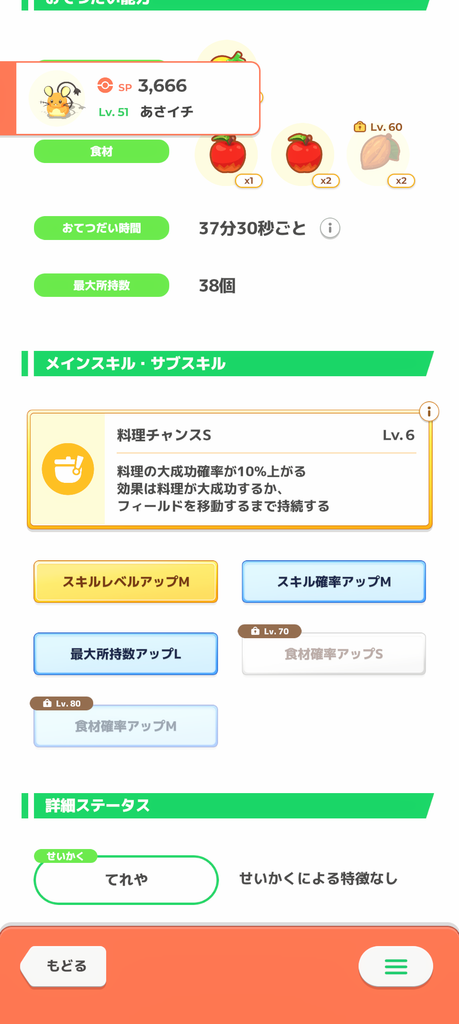
It has Skill Trigger M along with a Sub Skill that increases its inventory capacity.
I sometimes keep Dedenne on my team overnight from Sunday to Monday. During long periods when I can’t check the game, additional inventory space helps delay the point at which its inventory becomes full.
That makes it useful for my overnight strategy, when I want to have a Main Skill activation ready in the morning.
However, if I could collect from Dedenne frequently throughout the day, I might prefer Helping Speed instead. Inventory Up isn’t universally valuable for every Skill specialist; its usefulness depends on how you play.
For my full Skill specialist selection criteria, see:
Pokémon Sleep Skill Specialist Guide: Best Natures, Sub Skills, and Selection Criteria
I Don’t Judge Natures Simply as Good or Bad
I don’t automatically reject a Pokémon because of a single unfavorable Nature modifier.
Helping Speed Down Can Sometimes Be Acceptable
A Nature that reduces Helping Speed is certainly a disadvantage. However, I also consider which stat it increases in return.
For example, Bold reduces Helping Speed but increases Energy recovery. When paired with a healer, the increased recovery can help that Pokémon maintain higher Energy levels.
Of course, this doesn’t eliminate the Helping Speed penalty. It can be particularly noticeable on Berry specialists that stay on the team for long periods. However, for Ingredient specialists or Skill specialists that I only use temporarily, I may accept it if the rest of the build is good.
I Consider the Long-Term Cost of EXP Down Natures
One of the Nature modifiers I’m most cautious about is EXP Down.
Reduced EXP gains make it more difficult to reach higher levels and increase the time and Candies required for training. After raising several Pokémon with EXP Down Natures, I’ve become much more conscious of the resources needed to reach their theoretical potential.
On the other hand, EXP Up can be particularly useful for Pokémon that are difficult to train or require Candies that aren’t easy to obtain.
I especially appreciate EXP Up on Berry specialists because their Berry Strength increases with level. However, the best Nature still depends on Candy availability and the Pokémon’s other traits.
I Also Consider Strengths Outside a Pokémon’s Main Specialty
Improving a Pokémon’s primary specialty is important, but I also consider additional utility when it meaningfully improves how I can use that Pokémon.
The Value of Skill Level Up M Depends on the Main Skill
For example, my Swampert has Berry Finding S, Skill Level Up M, and Helping Bonus.
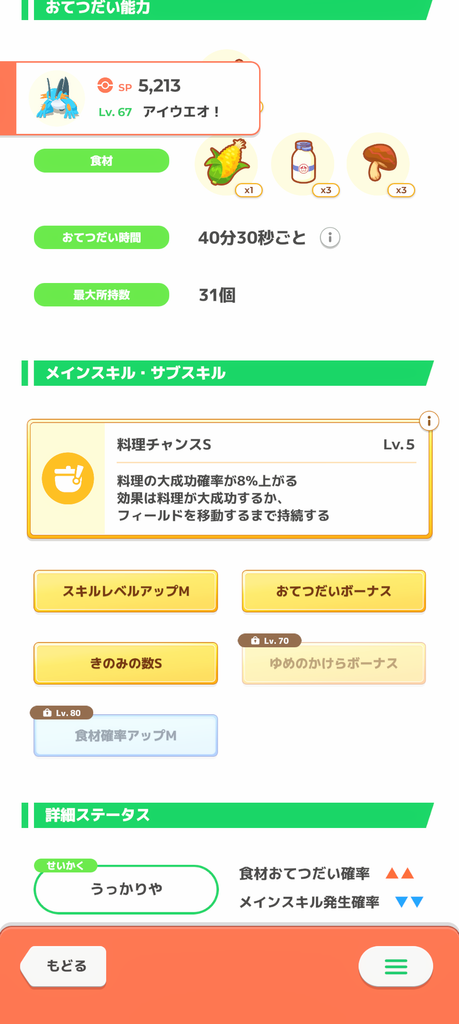
It’s already an excellent Berry specialist, while Skill Level Up M also improves the effect of its Main Skill. Its Rash Nature reduces Main Skill chance, but the higher Skill Level makes each activation more valuable.
The same principle can apply to Ingredient specialists. Blissey, for example, has Energy for Everyone S, so increasing its Main Skill Level can make its team-wide recovery more useful.
On the other hand, my Aggron has Charge Energy S and a Nature that increases Main Skill chance. In practice, it already maintains high Energy levels consistently, especially when paired with a healer.
For a Pokémon like that, additional Main Skill Levels may offer relatively little practical benefit in my usual team setup.
Rather than treating Skill Level Up M as universally good or bad, I evaluate how much the increased Main Skill Level would actually change a Pokémon’s usefulness.
I’ve explored this topic in more detail here:
Is Skill Level Up M Good? How to Evaluate It for Team Building
Whether You Need a Pokémon Right Now Also Matters
There’s value in continuing to hunt until you find an ideal Pokémon. However, going without an important team member while you search can also have a cost.
When a new research area is introduced and I need a Pokémon that can contribute immediately, I sometimes lower my usual selection standards.
Sometimes a Good Pokémon Today Is Better Than a Perfect One Next Year
I made a similar decision when raising my Dragonite.
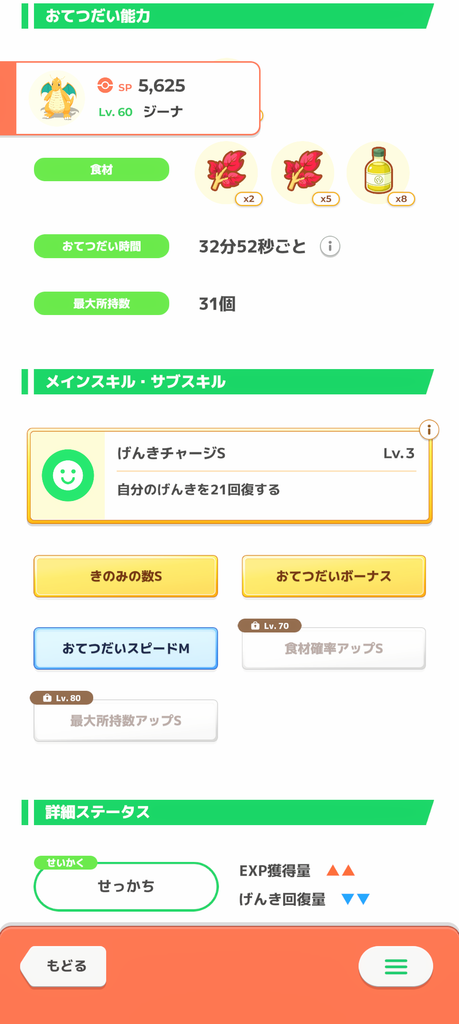
Although Dragonite is an Ingredient specialist, mine has Berry Finding S and other traits that improve helping performance, along with an EXP-increasing Nature.
When preparing for a new research area, I could have started hunting for a more specialized Berry specialist. However, finding an excellent Pokémon and raising it to a useful level would have taken a considerable amount of time.
Instead, I decided to raise the Dragonite I already had and put it to work right away.
That allowed me to improve my team immediately while continuing to hunt for better Pokémon at my own pace. I don’t regret that decision.
The possibility of finding a stronger Pokémon in the future doesn’t mean your current Pokémon isn’t worth raising.
Stopping Your Hunt and Starting Training Are Different Decisions
Even when I find an excellent Pokémon, I don’t necessarily start training it immediately.
I treat “This Pokémon is good enough to stop hunting” and “I should invest resources in this Pokémon right now” as two separate decisions.
One example is a Happiny I currently have in my Pokémon Box.
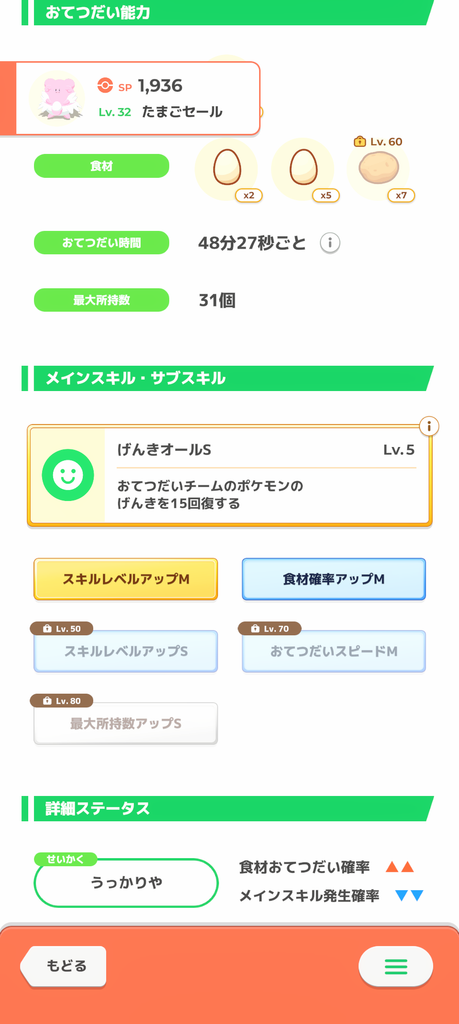
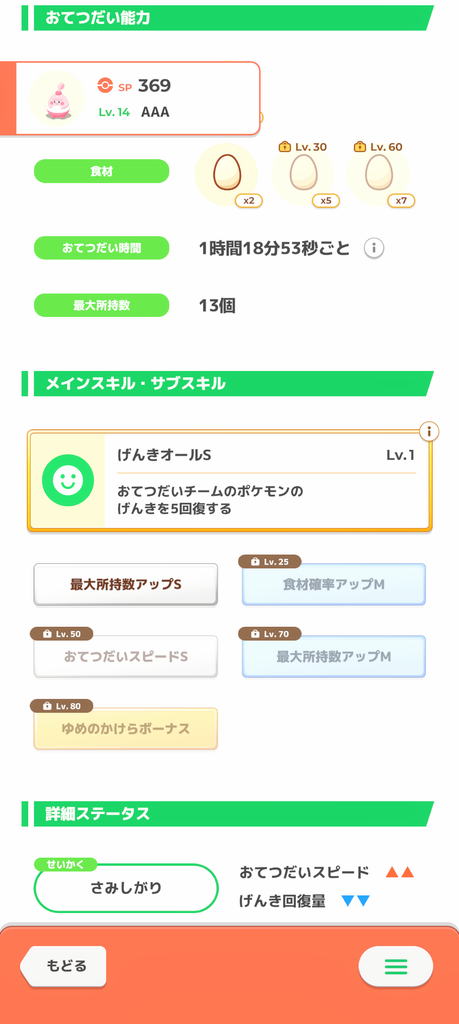
I previously raised a Blissey with a less-than-perfect build because I needed a Pokémon to collect Fancy Eggs. Later, I found a Happiny that was significantly better suited to that role.
The Happiny has Fancy Eggs in all three ingredient slots, Ingredient Finder M, Helping Speed S, and a Helping Speed-increasing Nature.
If I were comparing only ingredient production, I’d be tempted to replace my current Blissey. However, the Blissey I already raised can still supply the Eggs I currently need, so I’ve decided not to invest in Happiny yet.
If future recipes require considerably more Eggs, or if my existing Blissey can no longer keep up with demand, I can raise Happiny at that point.
I Prefer Investing Training Resources When I Actually Need Them
Raising Pokémon to high levels requires substantial amounts of Candies and Dream Shards. Skill specialists may also need valuable Main Skill Seeds.
Once these resources have been used, they can’t simply be transferred to another Pokémon.
That’s why, apart from situations where preparation such as sleeping with a Pokémon is necessary, I generally prefer waiting until I’m close to needing a Pokémon before investing heavily in it.
Finding an excellent Pokémon is valuable, but having a great Pokémon in your Box doesn’t mean you must raise it immediately.
What Influenced My Personal Selection Criteria
My current approach was partly influenced by someone who previously shared Pokémon Sleep strategies and selection advice.
At the time, they introduced a simple scoring approach for Berry specialists, assigning points to valuable Sub Skills and Natures.
As I remember it, Berry Finding S received the highest score, while Helping Bonus, Helping Speed, and other useful traits contributed additional points.
I no longer use that scoring system, and I can’t confidently reproduce the original values. However, the underlying idea had a lasting influence on me: a Pokémon doesn’t need to be perfect if it already has enough strengths to fulfill its role.
As I continued playing, I gradually began considering more factors, including ingredient spreads, Main Skills, the difficulty of hunting a particular Pokémon, available training resources, and when I actually need it.
There Isn’t One Correct Way to Choose Pokémon
Hunting for the strongest possible Pokémon is a perfectly valid way to enjoy Pokémon Sleep.
However, I also believe it’s useful to establish reasonable standards based on your existing team and personal playstyle.
For example, even if a Pokémon isn’t the strongest option according to a calculator, it may still be valuable because it’s easier to train or can immediately fill a role your team needs.
I’ve raised plenty of Pokémon knowing that stronger individuals were theoretically possible. But if they performed well when I needed them, I don’t consider those investments mistakes.
Final Thoughts: Build Selection Standards That Work for You
My most important criterion when choosing a Pokémon is whether it can fulfill the role I need.
From there, I adjust my standards according to my existing team, the difficulty of finding a better Pokémon, and the resources required for training.
Rather than judging Pokémon by their individual performance alone, I consider what each one can contribute to my current team. That’s the approach that has worked best for me throughout my time playing Pokémon Sleep.